73% of Mid-Sized Manufacturers Stuck in AI Pilot Phase as Data Infrastructure Gaps Persist
The Reality of Mid-Market AI Deployment
A new study by Kaufman Rossin has revealed a stark disconnect between the desire to adopt artificial intelligence and the practical ability to do so within the mid-sized manufacturing sector. While intent and budgets for AI are soaring, 73% of mid-sized manufacturing companies remain stuck in the testing or basic preparation phases of AI deployment. Even more striking, not a single mid-sized manufacturer surveyed has managed to fully deploy and operationalize AI across its business operations.
This "pilot purgatory" is not unique to industrial firms—the same 73% preparation-stage figure applies to the broader mid-market sample. However, the path to scaling AI is exceptionally narrow, with only 7% of overall mid-market companies currently positioned to scale these technologies company-wide.
The Legacy ERP Obstacle
The research highlights that the primary hurdle to AI adoption is not the AI software itself, but rather the foundational technology systems already in place. Every single manufacturing company surveyed relies on an Enterprise Resource Planning (ERP) system. While ERPs are universal in the industry, their legacy architecture represents a massive roadblock.
These older ERP platforms were never designed to connect natively with modern AI tools. Consequently, 55% of manufacturers cite this integration gap as their single greatest obstacle to AI deployment. In comparison, only 41% of the wider mid-market struggles with this same issue, showing that manufacturers face significantly more friction when connecting legacy systems to AI. This problem is further compounded by years of custom layers built onto ERP environments, which makes retrofitting data pipelines or API connections slow, costly, and heavily reliant on vendor support.
The Data Infrastructure Gap
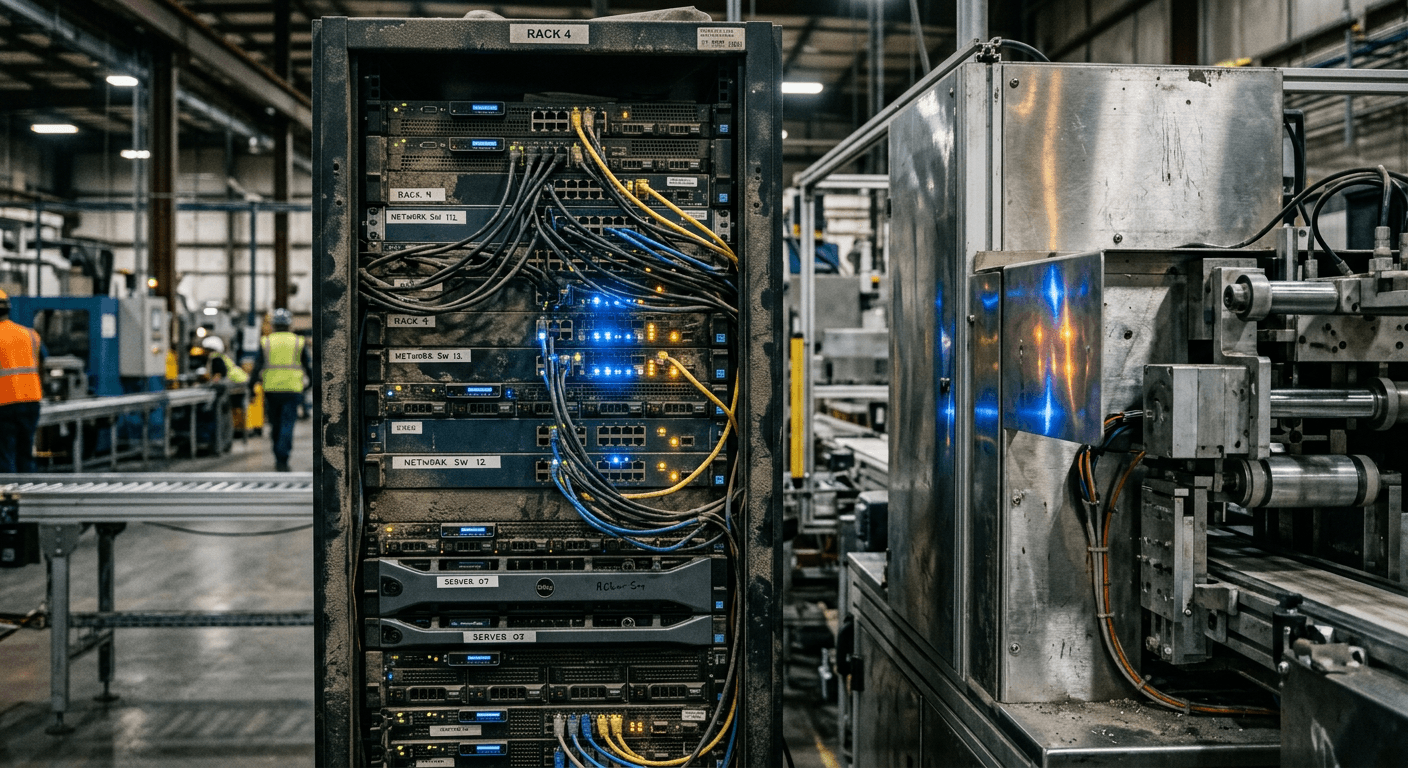
Beyond ERP limitations, manufacturers suffer from a severe data-readiness deficit. AI systems require consistent, high-quality data inputs to function effectively, yet many manufacturers lack the infrastructure to provide them.
Only 27% of surveyed manufacturing companies maintain a data warehouse or data lake, compared to 60% of firms in the broader mid-market. This means industrial organizations are operating at less than half the data-readiness rate of their non-industrial peers. Additionally, approximately 45% of manufacturers still operate with siloed data, and none of the studied manufacturers utilize machine learning platforms. Looking at the wider mid-market, only 16% of organizations have achieved a fully managed and integrated data state capable of supporting AI systems properly.
Misinterpreting Narrow Wins
While wide-scale operational AI remains out of reach, many manufacturers have achieved isolated, narrow successes. These typically include time savings on highly specific tasks, the automation of a single accounting function, or localized productivity gains within individual processes.
However, Kaufman Rossin's research flags a key risk: companies often mistake these limited pilot successes for a completed AI journey. When a narrow pilot succeeds, organizations frequently reallocate budgets and declare victory prematurely, leaving the deeper, underlying data infrastructure problems unresolved.
High Intent, Weak Infrastructure
Despite these significant technical and structural challenges, the appetite for AI investment remains incredibly high among mid-sized manufacturers. Every manufacturer surveyed agreed that AI technologies save time, and 91% plan to increase their AI budgets.
This combination of strong financial intent and weak technical infrastructure creates a compounding risk. Without addressing the underlying data silos and ERP integration gaps, increased spending will likely only generate more isolated pilot programs rather than the cohesive, production-ready AI deployments these organizations hope to achieve.