

The AI Industrial Revolution: What Naval's Panel Means for Growth Founders
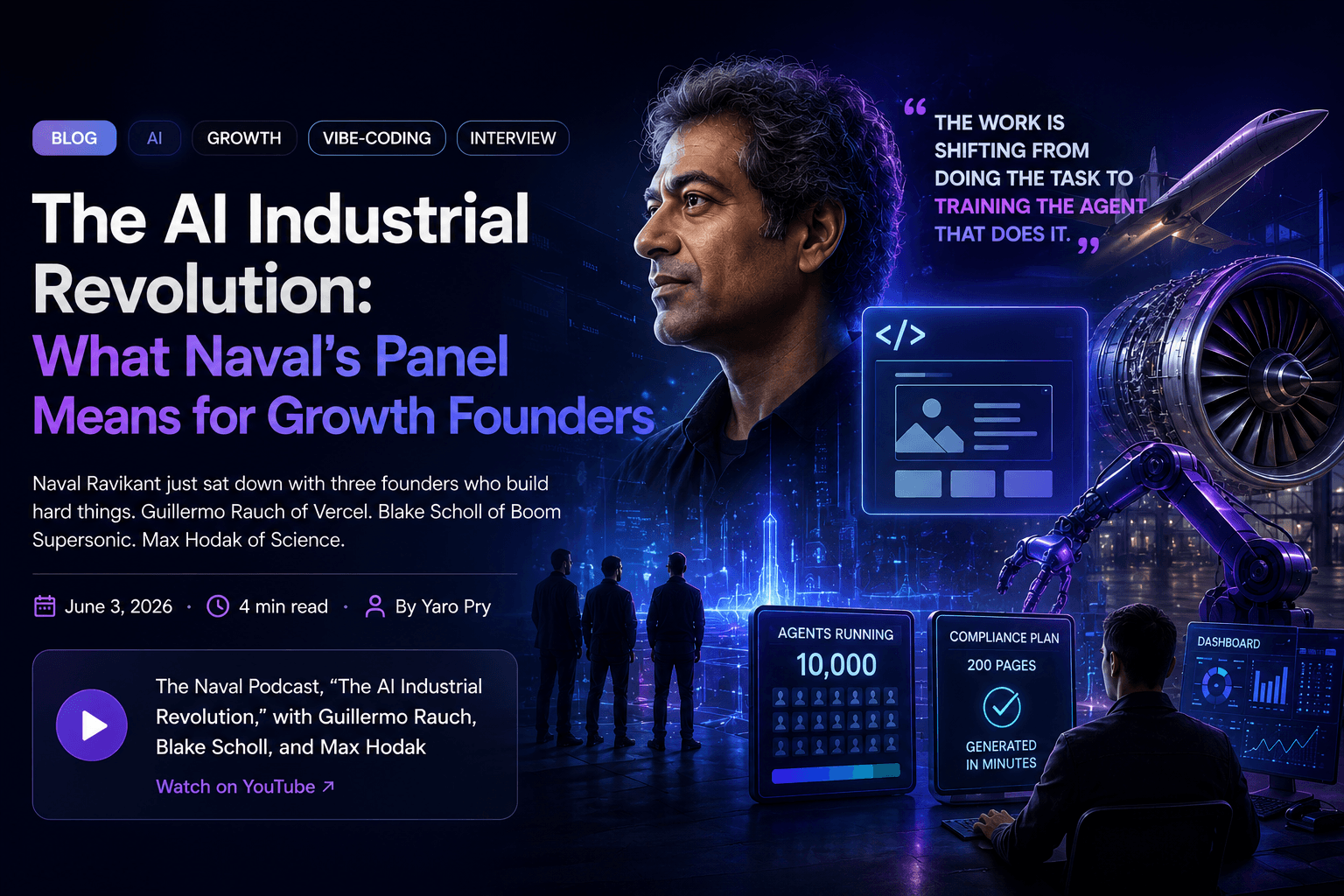
Naval Ravikant just sat down with three founders who build hard things. Guillermo Rauch of Vercel. Blake Scholl of Boom Supersonic. Max Hodak of Science.
On paper it's a chat about software, jet engines, and brain-computer interfaces. It isn't, really. It's about one thing: where leverage went.
And it went somewhere uncomfortable for most teams. Out of technical execution. Into human taste, judgment, and nerve. If you're building an audience or a product, that quietly rewrites your playbook. Here's the part that matters for growth people.
1. "Vibe coding" just deleted your engineering bottleneck
The panel makes a claim that sounds like hype until you sit with it. Classic, line-by-line software engineering is turning into a manual trade. A shrinking one.
Models now take fuzzy, sloppy English and hand back working software. Max and Naval say they've moved almost entirely to "vibe coding" - you give the model your intent, then you check what it built. You stop typing every line yourself.
For a growth team, that's the whole headline. The marketer who always needed "an engineer for that"? They can build the landing page test now. The scraper. The internal dashboard. The onboarding flow that's been stuck in the backlog since March.
The founder's job shifts too. Less creator, more verifier. The person who signs off that the thing is correct, secure, and ready to ship.
So stop scoping your ideas to what the eng backlog allows. The backlog isn't the constraint anymore. Your taste about what's worth building is.
2. The 100x operator is real now, and the team is tiny
Remember arguing about whether the "10x engineer" actually existed? That debate is over. The panel's number is 100x. Sometimes 1,000x.
Nobody got smarter. AI just turned one person into a factory.
The examples are almost silly:
- Two engineers at Boom now do the structural and aerodynamic design for a whole jet engine in real time. That used to be one engineer, one spreadsheet, one turbine blade, one day. Per blade.
- Vercel pointed 10,000 agents at an open-source security tool and got months of red-teaming done in a couple of days. Cost? About $14,000 in tokens.
The lesson here isn't "go hire a 100x person." It's that small teams ship like big ones now. The bar to launch something serious has basically collapsed. Which cuts both ways - more competitors, but a lot more room for you to punch above your headcount.
3. Hand out agency. The receptionist might ship your next feature
This was the moment that stuck with me. One founder ran a company-wide week where everyone had to build an AI tool. Everyone. The receptionist included.
A few of those tools turned out to be trajectory-changing. Built by people who'd never touched the product before.
The takeaway for how you run a growth org is simple. Spread the right to build. When base intelligence is something you can just prompt, the real constraint is who's willing to try. The curious generalist with high agency now beats the credentialed specialist sitting around waiting for a spec.
4. Taste is the only moat left
If intelligence, domain knowledge, and execution are all cheap tokens now, what's actually defensible? The panel's answer is short. Creativity. Taste. Judgment.
Max defines real innovation as "meaningful, out-of-distribution behavior." Something that wasn't in the training data and changes where the viewer was headed. Naval frames it differently - art is the conveyance of human intent. A photo a person chose to take beats an identical AI render every time, because the intent is the thing you're actually paying for.
For marketers, that's the entire game.
AI slop is about to be everywhere. Generic posts. Generic pages. Generic ads. Infinite, and free. The only thing that cuts through is a point of view. A surprising angle. A brand that feels like somebody actually made it. The bar for surprising your audience keeps rising, and clearing it is now your real job.
5. Aim AI at the boring work, including the paperwork
A theme kept coming back: AI is at its best chewing through mountains of slop.
Boom drafts a 200-page airplane compliance plan in minutes now. That used to take months. The side effect is sneaky-important - when paperwork stops hurting, you stop being afraid to change things. They iterate on physical specs as fast as software. The panel even jokes about "red queen races," where founders flood regulators with AI-written compliance and regulators answer with agents of their own.
You probably don't file aviation paperwork. But you've got your version. SRE. QA. First-draft copy. Research. Reporting. Reconciliation. Automate the boring middle so your human hours go to the creative and architectural calls. The stuff that actually moves the number.
One honest caveat, though. Zero-to-one is trivial now. Day 1,000 isn't. Spinning up software is easy. Keeping it secure, fast, and alive is still hard, human work. Don't mistake a quick launch for a durable product.
So what do you do with all this
The edge isn't the biggest team or the most code anymore. It's agency. The willingness to point AI at the boring work - coding, ops, legal, research - so your attention goes entirely to growth and the big decisions.
If you take one line from Naval's panel, take this. The work is shifting from doing the task to training the agent that does it.
The founders and creators who get that first won't just survive the AI industrial revolution. They'll be the ones writing it.
The Naval Podcast, "The AI Industrial Revolution," with Guillermo Rauch, Blake Scholl, and Max Hodak
Source: The Naval Podcast, "The AI Industrial Revolution," with Guillermo Rauch, Blake Scholl, and Max Hodak. Watch on YouTube.