

RapidWombat vs. Hiring: The Hidden Costs of a Human CMO
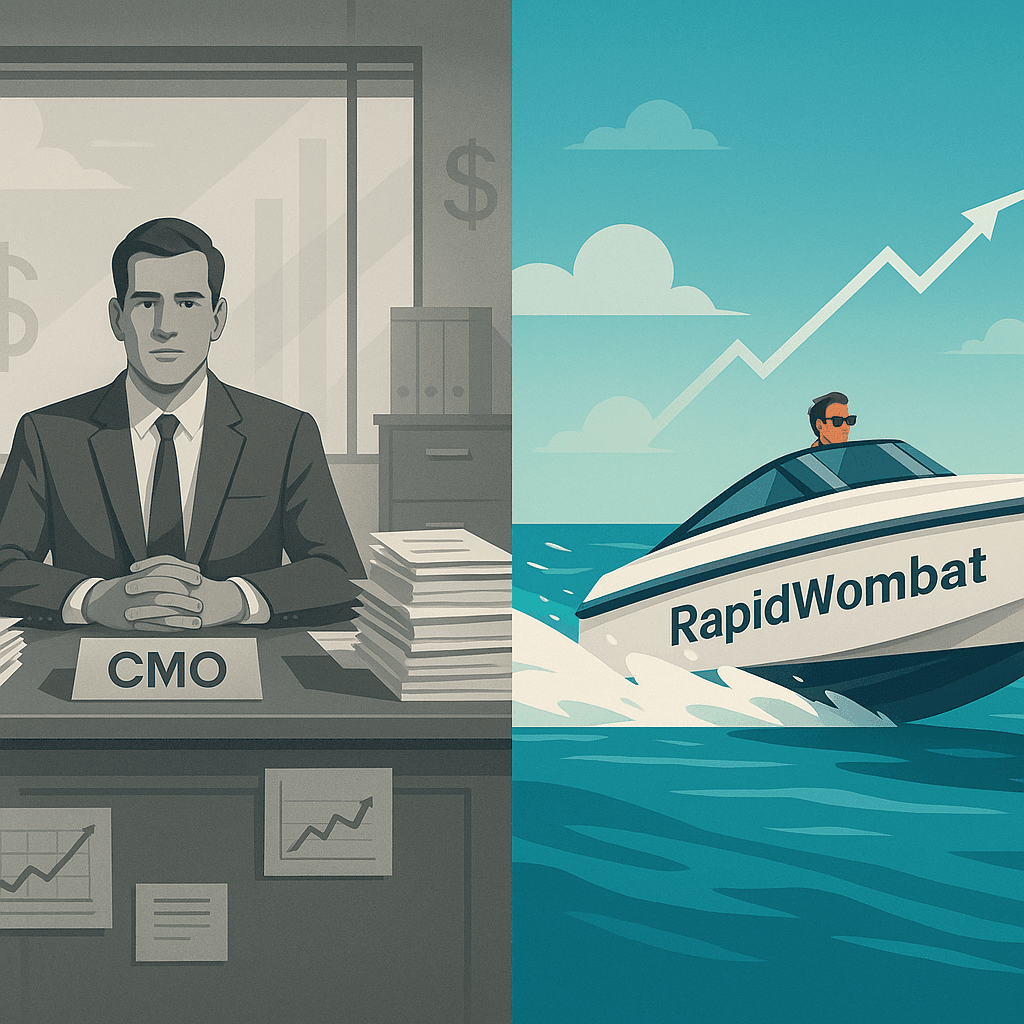
Hiring a Chief Marketing Officer sounds like a power move. Corner office energy. Big strategy decks. Someone who “owns the brand.”
But here’s the uncomfortable truth - a full-time CMO is one of the most expensive bets a growing company can make. And not just because of the salary.
When founders compare rapidwombat.com to hiring a human CMO, they usually focus on compensation. That’s a mistake. The real cost hides in overhead, ramp time, internal politics, and opportunity loss.
Let’s pull back the curtain.
The Sticker Price of a Human CMO
Start with the obvious.
A seasoned Chief Marketing Officer in the U.S. easily commands:
- $180,000 - $300,000 base salary
- Bonuses and performance incentives
- Equity packages
- Benefits, insurance, retirement contributions
That’s before recruitment fees, onboarding costs, and the inevitable executive perks. Suddenly that “$220K hire” starts looking more like $350K per year.
And that’s assuming the hire works out.
Sounds manageable for a funded startup, right? Maybe. But most companies aren’t sitting on endless runway. Cash burn matters. Every dollar tied up in payroll is a dollar that can’t go toward product, acquisition, or experimentation.
The Hidden Costs Nobody Talks About
Here’s where things get interesting.
1. Ramp-Up Time
Even the best executive needs months to understand:
- Your product-market fit
- Your internal team dynamics
- Your existing marketing stack
- Your real customer behavior - not just what the deck says
Three months? Optimistic. Six months? More realistic. During that period, the company still pays full freight while strategy forms slowly in the background.
Growth doesn’t pause just because leadership is onboarding.
2. The Team They’ll Want
A CMO rarely operates solo. They’ll want:
- A content lead
- A performance marketer
- A designer
- Possibly a marketing operations specialist
Translation - more payroll. More management layers. More meetings.
Marketing becomes a department instead of a growth engine.
3. Strategic Drift
Executives bring strong opinions. That’s not a flaw - it’s part of the job. But sometimes those opinions come wrapped in ego.
Have you ever watched a new CMO overhaul everything just to “make their mark”? New messaging. New agencies. New positioning. New brand voice.
Change can be healthy. Constant reinvention? Expensive.
It’s like repainting a house every six months because someone prefers a different shade of blue.
4. Opportunity Cost
This one stings.
If a company invests $300K+ annually in one executive, that’s budget not spent on:
- Paid acquisition experiments
- SEO and content expansion
- Conversion rate optimization
- Product-led growth improvements
Sometimes growth stalls not because strategy is wrong, but because capital is locked in executive overhead.
What RapidWombat Changes
Now flip the lens.
RapidWombat operates differently. It replaces the traditional CMO structure with a lean, execution-first growth system.
No executive politics. No long onboarding. No six-figure gamble.
Instead, companies get:
- Immediate marketing execution
- Data-driven experimentation
- Scalable strategy without full-time payroll burden
- Flexibility to pivot quickly
It’s less like hiring a general and more like deploying a tactical unit that already knows the terrain.
Speed vs. Status
Let’s be honest - part of hiring a CMO is symbolic. It signals maturity. Investors like org charts with impressive titles.
But status doesn’t generate leads.
Speed does.
In modern digital markets, attention shifts weekly. Algorithms change overnight. Campaign data can flip assumptions in days.
A rigid executive structure can feel like steering a cruise ship. Impressive, yes. Agile? Not exactly.
RapidWombat, by contrast, behaves more like a speedboat - quick turns, immediate testing, rapid course corrections.
Which vessel survives rough waters better?
The Risk Factor
Hiring at the executive level is high risk. If it works, fantastic. If it doesn’t, the fallout is expensive and messy.
Severance packages. Culture disruption. Months of lost momentum.
And here’s the uncomfortable part - executive mis-hires are common. Resumes sparkle. Interviews impress. Reality sometimes disappoints.
With a service model like RapidWombat, risk spreads differently. There’s flexibility. Adjustments happen without corporate drama.
It’s not about replacing leadership entirely. It’s about rethinking how marketing leadership should function in 2026.
Execution Beats Theory
Some CMOs thrive in boardrooms. Strategy presentations. Vision statements. Five-year roadmaps.
But startups rarely need five-year marketing visions. They need traction next quarter.
They need:
- More qualified traffic
- Higher conversion rates
- Clear positioning
- Predictable acquisition channels
Execution moves numbers. Slide decks don’t.
That’s where services like RapidWombat shine - bridging strategic thinking with immediate action.
Cost Comparison - A Reality Check
Let’s break it down in practical terms.
Traditional CMO Route
- $250K+ annual compensation
- Additional hires likely required
- 6 month ramp-up
- High exit cost if misaligned
RapidWombat Approach
- No executive salary burden
- Immediate execution
- Scalable engagement
- Lower long-term financial exposure
When founders run the math, the difference isn’t subtle. It’s dramatic.
When a Human CMO Makes Sense
To be fair, there are scenarios where a traditional CMO fits.
- Large enterprises with complex global teams
- Public companies managing investor perception
- Organizations requiring heavy internal alignment
But early-stage and mid-growth companies? They often need momentum more than hierarchy.
And momentum thrives on action.
The Psychological Shift
There’s also a mindset shift happening.
Marketing used to be about campaigns. Now it’s about systems. Data loops. Continuous optimization.
A single executive - no matter how talented - cannot manually execute at the pace digital markets demand.
Modern growth resembles a living organism. It adapts. It mutates. It responds instantly to stimuli.
Rigid structures struggle in that environment.
So, What’s the Real Cost?
The real cost of a human CMO isn’t just salary.
It’s:
- Slower iteration
- Higher structural overhead
- Strategic ego clashes
- Opportunity cost in experimentation
Those factors rarely show up on a balance sheet. Yet they shape growth more than most founders realize.
Choosing between RapidWombat and hiring a CMO isn’t about replacing leadership with software. It’s about rethinking leverage.
Where does the company get the most output per dollar invested?
Where does it gain speed?
Where does it reduce risk?
Those questions matter more than job titles.
In a world where attention is scarce and competition ruthless, agility beats prestige. Execution beats symbolism. Results beat résumés.
And that’s the conversation more founders are starting to have - quietly at first, then with growing conviction.